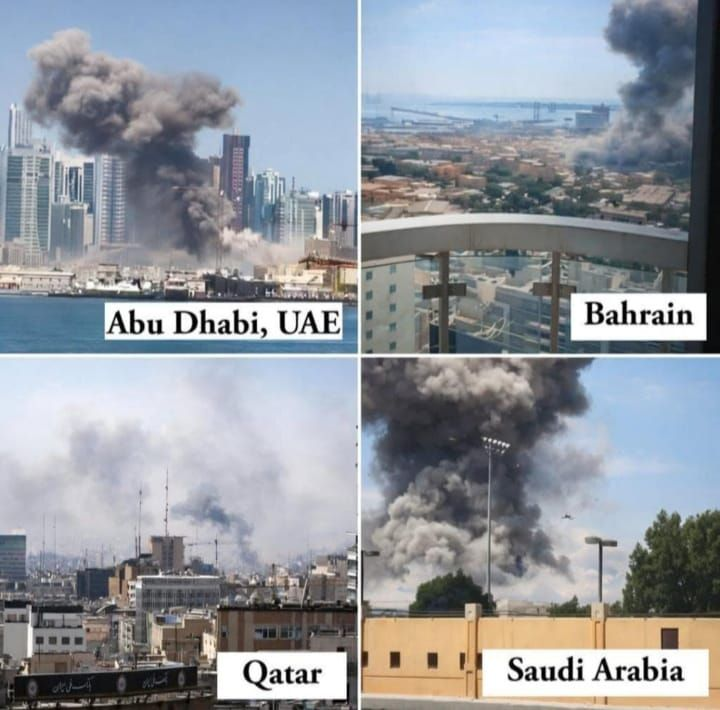
The visual depiction of massive smoke plumes rising over iconic Middle Eastern cities like Abu Dhabi, Bahrain, Qatar, and Saudi Arabia instantly commands attention and underscores the critical importance of regional stability. When analyzing geopolitical dynamics or security events across the Gulf Cooperation Council nations, understanding the visual context of such incidents becomes paramount for international observers. The footage powerfully illustrates how dense columns of dark smoke can billow high into the sky, creating a stark and sobering contrast against modern urban skylines and coastal backdrops. In the upper-left quadrant of the display, the scene from Abu Dhabi in the United Arab Emirates captures a dramatic explosion near the waterfront, sending a massive cloud of gray and black smoke into the air while towering skyscrapers stand prominently in the distance. Simultaneously, the top-right segment focusing on Bahrain showcases a similarly intense plume rising from what appears to be a coastal or port area, with a bright flash of fire visible at the base of the smoke trail. Moving to the lower-left section, the footage labeled Qatar depicts a dark trail of smoke stretching across the city, while a fighter jet sharply maneuvers through the airspace, leaving a distinct white vapor trail behind it. The final quadrant on the bottom right reveals a massive wall of dark smoke rising behind a stadium or public facility in Saudi Arabia, where another aircraft is seen performing a tight, looping turn that generates a sharp white smoke ring against the gray sky. These synchronized depictions emphasize the visual scale of these events, highlighting how aerial operations and ground-level explosions can dramatically alter the appearance of heavily populated metropolitan areas. From a strategic perspective, the presence of military aircraft weaving through these smoke columns suggests active defense measures, air superiority demonstrations, or tactical response exercises taking place within the region. The juxtaposition of sophisticated military jets performing high-speed maneuvers alongside heavy industrial smoke creates a vivid narrative about readiness, response capabilities, and the complex nature of modern security frameworks. Furthermore, the clear labeling of each specific country enables viewers to instantly identify the geographic scope of the events, reinforcing how interconnected these nations are when it comes to regional monitoring and security. Observers of Middle Eastern defense strategies often analyze this type of footage to evaluate the response times of tactical aircraft and the effective management of airspace during high-intensity scenarios. The intense visual elements, combined with the unmistakable roar of jet engines, provide a sensory-heavy experience that highlights the serious nature of these simulated or actual defense operations. By examining the patterns of the smoke and the precise trajectories of the aircraft, aviation enthusiasts and defense analysts alike can gain insight into the maneuvering capabilities of modern fighter technology under challenging conditions. The video serves as a compelling reminder of how rapidly an urban landscape can be transformed visually by large-scale incidents, drawing focus to the resilience of infrastructure and the readiness of defense forces. Each segment offers a distinct perspective on how smoke plumes interact with local topography, whether it is the waterfront of Abu Dhabi, the coastal reaches of Bahrain, the urban density of Qatar, or the open facilities of Saudi Arabia. The continuous looping of the aircraft through the smoke clouds underscores the high level of pilot training required to navigate environments with potentially reduced visibility or turbulent air currents. As the white vapor trails contrast sharply with the dark, billowing smoke, the footage creates a highly dramatic aesthetic that captures the essence of modern aerial engagement and emergency response. This comprehensive visual overview provides a unique look into the complex tapestry of defense, vigilance, and technological sophistication defining the contemporary landscape of the Gulf region.